Airbus Defence & Space has just commemorated the first ten years of its factory in San Pablo Sur in Seville. with a festive open day for employees and their families. Through various recreational and informative activities such as augmented reality games, access to the interior of the aircraft and a spectacular air parade, the exciting work of aircraft engineering and manufacturing became even more widely known. It is an industrial sector that directly and indirectly generates a significant number of highly skilled jobs, which has a direct and indirect impact on the great benefit to the regional and national community.
Airbus DS has three factories in the city, reflecting a modern-day tradition of aircraft manufacturing that dates back to the origin of aviation.
Seville forms part, along with a dozen other cities around the world, of a select club of locations where there are means to design, assemble and test a complete aircraft. These capabilities have been present since practically the origin of aviation thanks to historical companies such as Hispano Aviación or CASA. Their experience and knowledge have served as a legacy for current companies such as Alestis or Airbus Defence & Space.
Airbus has a total of three plants around the city of Seville: Tablada and San Pablo, which in turn is divided into North and South. To learn about the origin and history of these factories, we must go back more than a century ago to the Tablada neighbourhood, where we also find the birth of aeronautics in Seville.
At the beginning of the 20th century, the city had barely 150,000 inhabitants, less than a fifth of what it has today. Tablada was no more than a huge meadow located on the other side of the river that separates the Triana neighbourhood from the rest of the city. It was owned by the municipality and was used for grazing cattle and fighting bulls. It was a flat piece of land with hardly any obstacles, as the only construction was a hippodrome that the Sociedad de Carreras de Caballos (Horse Racing Society) had built in 1880. But it was precisely these characteristics that made the land an excellent natural aerodrome for the incipient aeronautical industry. In 1910, barely 6 years after the Wright brothers invented the aeroplane, the modest site was the venue for the a week dedicated to aviation with speed displays, take-offs, manoeuvres etc.
In 1914, the town council ceded part of this land, some 24 hectares, to the state for the construction of a new building. construction of a military airfieldThe germ of the future Tablada air base. As early as 1921, these facilities were already used for the first commercial flight of a Spanish-owned companyIn 1923, the city council built the first civilian facilities at one end of the military airfield, the newly created CETA, between Seville and Larache, a city in northern Morocco. In 1923 the city council built the first civilian facilities at one end of the military airfield.
That same year, José Ortiz Echagüe founded Construcciones Aeronáuticas S.A. (CASA) in Getafe (Madrid). The company grew in line with the strength of the sector and in 1942 it finally established its first plant in Seville. It did so, of course, around the already consolidated Tablada airport. Therefore, the factory recently celebrated its 75th anniversary. Models such as the C-2111 or the C-101 have been manufactured here, as well as components and structures for a wide variety of other programmes.
In the 1940s, the city demanded new extensions of land for its growth, while Tablada airport was becoming obsolete, so in 1945 it was decided to build another airport, San Pablo, on land to the north of the city, near the site of the old airship terminal.
CASA, for its part, builds a couple of hangars around it around 1960 and finally moves on to occupy the premises of the company Hispano Aviaciónwhich disappeared in 1972. Thus was born its second factory, now known as San Pablo Norte. It will be used to manufacture and assemble new models such as the CN-235 and C295.
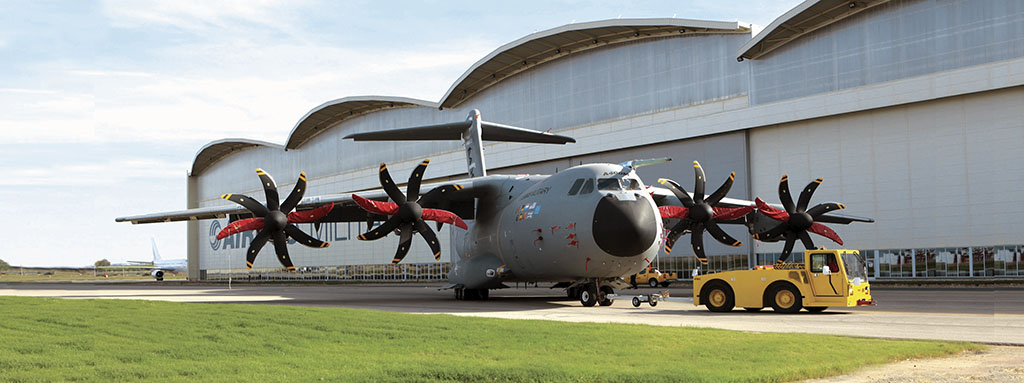
In the 1990s, a new initiative was launched in several European countries, the A400M military aircraft programmeThe A400M, which was intended to become the future military airlifter to replace the Lockheed C-130 Hercules and Transall C-160 aircraft of this type in use by the major European armies. At the end of the decade, Spain's CASA, France's Aerospatiale Matra and Germany's Dasa join forces to form EADS and take over development of the A400M programme.
It was necessary to choose where to locate the Final Assembly Line (FAL) and the candidates were some of the existing sites. From Seville, a promotional campaign was carried out under the slogan ".the right choice". He asserted its long experience in military aviationToulouse and Hamburg, also candidates, lacked. In addition, these countries were already immersed in the development of Airbus' new civil programme, the A380, which is why the Andalusian city was finally chosen.
With a view to the development of the new programme, in 2009, an innovative and spacious facility called San Pablo Sur was inaugurated to the south of Seville airport.
In 2013, EADS adopted the name Airbus Group, and one of its divisions, military and space, was renamed Airbus Defence & Space.
This has been the story, but what does the future hold?
Over time, the three factories have continually reinvented themselves to adapt to changes in programmes they developed.
Tablada, after recent investments, remains at the forefront of manufacturing, consolidating its position as a Pre-FAL plant and delivering equipped components to other FALs, both in San Pablo and outside Seville, such as the Airbus Group factory in Getafe (with the Eurofigther and MRTT programmes) and even to those of the competitor Boeing.
The San Pablo Norte factory transferred the production of the former CASA models (CN-235 and C295) to San Pablo Sur, so it has been re-adapted as a maintenance, repair and overhaul service centre (MRO).
San Pablo Sur, for its part, has delivered approximately half of the initial 180 A400M orders and will continue this activity for at least another ten years, although it is already looking for and developing new projects such as the retrofit of aircraft already delivered.
Know-how and specialisation have been basic pillars throughout the history of these three factories, but another of the aspects that has recently contributed most to adapting them to the constant evolution and adoption of new programmes is the the emergence of the Industry 4.0 or factory of the future conceptThis significantly improves and rationalises production processes, enabling them to remain competitive.