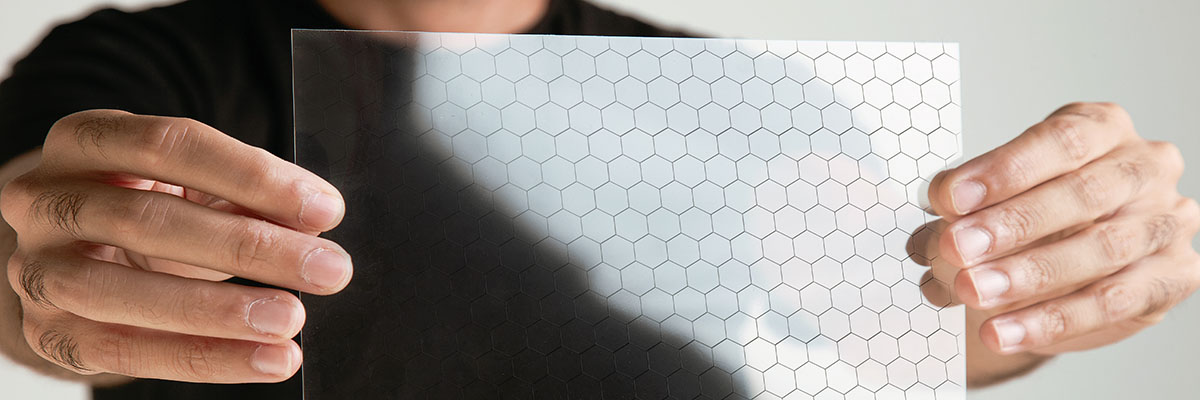
"The Material of the Future", "Friday Night Experiment" or the "New "Soft" Material" are the names given to this product resulting from the curiosity of two university researchers. Graphene was not on the lab's official agenda.
When this material was discovered at the beginning of the 20th century, the potential it could reach was not imagined, since, despite being obtained from graphite, it was not considered to be the same material. It has been during the last 10 years when, as a result of the research of two scientists, one Dutch and the other Russian-British, its importance has been appreciated and has earned them the Nobel Prize in Physics, thanks to this "supermaterial".
1000 times more conductive than copper and 200 times stronger than steel
And I say supermaterial because, to date, no other large-scale industrialisable material with such characteristics and so many possibilities has been found. A material that is only one atom thick and organised in a honeycomb pattern, it is 1000 times more electrically conductive than copper and 200 times stronger than structural steel. It has few competitors left. What's more, it would take the weight of 3 cars concentrated on the tip of a biro to break a sheet of paper.
Applications such as roll-up touch screens, ultra-fast batteries that charge in seconds or microchips up to 1000GHz are already possible thanks to this material. The aeronautics industry will also benefit, because by adding graphene in small quantities to metals and plastics, lighter and stronger composites can be made. Vehicles such as aircraft and cars will see an increase in energy efficiency and safety. And where graphene is involved, the physical qualities are enhanced.
As a professional in the aerospace sector, I believe in the importance of continually investing in the use of cutting-edge components for the development of our own technologies, as well as investing and continuing to work on everything that will bring us back to a better quality in the aeronautical sector.