Climate change is living with us. Rising temperatures are already grounding some aircraft. Last summer, for example, a large number of regional flights had to be cancelled in Arizona because the maximum recommended temperature for this type of aircraft exceeded 48 degrees Celsius.
Climate change often sounds like a long way off, but it is clear that it is already affecting air transport.
Without going as far as cancellations, the increased temperatures will affect the maximum take-off weight of aircraft. At higher temperatures, the air density decreases, reducing lift, so aircraft will need to longer track lengths to achieve the necessary take-off speeds. At airports where runway length is insufficient, it will be necessary to reduce aircraft weight, either in the form of fuel or passengers. It is estimated that these weight reductions can be as much as 4% depending on aircraft type, runway length, runway elevation and actual temperature.
In the future, it is expected that between 10 and 30% of the annual flights flying at the hottest times of the day may face some restrictions. This is already being done on the hottest days at London City Airport.
For example, at Denver airport, which has 6 runways with a maximum length of 4877 metres, a Boeing 777-300 would have to reduce 5% of payload during the 53% of flights occurring during the hottest hours of the year. This would mean that 18% of passengers would not be able to fly, with a consequent detriment to the passenger experience, as well as the major economic impact for airlines. The solution would involve building longer and longer runways, but this is not always possible at existing airports.
Also, the increase in the rainfall intensity and frequency will cause delays by requiring increased separation between aircraft in flight, leading to a reduction in airport capacity. A generalised and sustained increase in precipitation will also require a review of the capacity of drainage systems to verify whether they can cope with heavier rainfall and avoid flooding of runways and aprons.
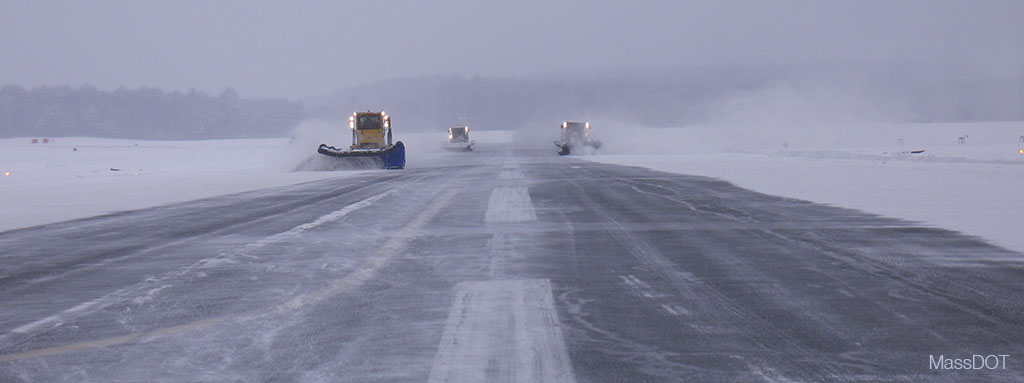
Considering that precipitation will be in the form of snow, it will also be necessary to provide airports with larger aircraft de-icing areas to avoid delays in take-offs.
Climate change is also predicted to lead to changes in the compass rose characteristic of some regions. As runways are built in the direction of the prevailing wind, these changes can lead to increased crosswinds, mainly resulting in an increased number of aborted landing manoeuvres and even the need to divert flights to other airports. As a result, it would be necessary to modify procedures and redesign the airspace with a consequent impact on the noise footprint in the area surrounding the airport.
As for the sea level rise, experts forecast a range of 0.5 to 2.0 metres for this century. This could mean permanent flooding of many airports located in close proximity to coastlines, as well as temporary flooding caused by tidal surges and storms.
Since half of the world's population lives within 60 km of the sea and three quarters of the world's major cities are located on the coast, many of the world's largest international airports are located almost at sea level. San Francisco airport is 4m above sea level, Amsterdam Schipol or Bangkok 3m.
In Europe, some 34 major airports are located in coastal or river flood zones.
Avinor, the owner and operator of 46 airports in Norway, has decided that all future runways will be built at least 7 metres above sea level, in a clear example of operators taking into account the foreseeable effects that climate change may have on airports.
Another concrete example of this problem can be found in the general facilities and runways at Oakland International Airport. They could be inundated by daily tidal surges with a sea level rise of only 40 cm, which is within the range of most mid-century projections. In addition, storm events on top of the 40 cm sea level rise could make some airports' main access roads impassable.
According to studies carried out by the San Francisco Bay Conservation & development Comminssion, In the year 2050, the sea level in San Francisco Bay will reach 24 inches (60cm). This increase would result in the flooding of almost the entire airport, as can be seen on their website (see here).
Clearly, there is no single solution to solve the problem of flooding of airports due to rising water levels and each situation will have to be analysed and assessed in its specific context.
In short, the implications of climate change at airports will affect passengers, airlines, local residents and operators. Therefore, it is necessary to start considering possible solutions for each airport.. Or to rigorously and decisively address all the measures that we can take to really reduce CO2 and that we do not continue to add to the problem.