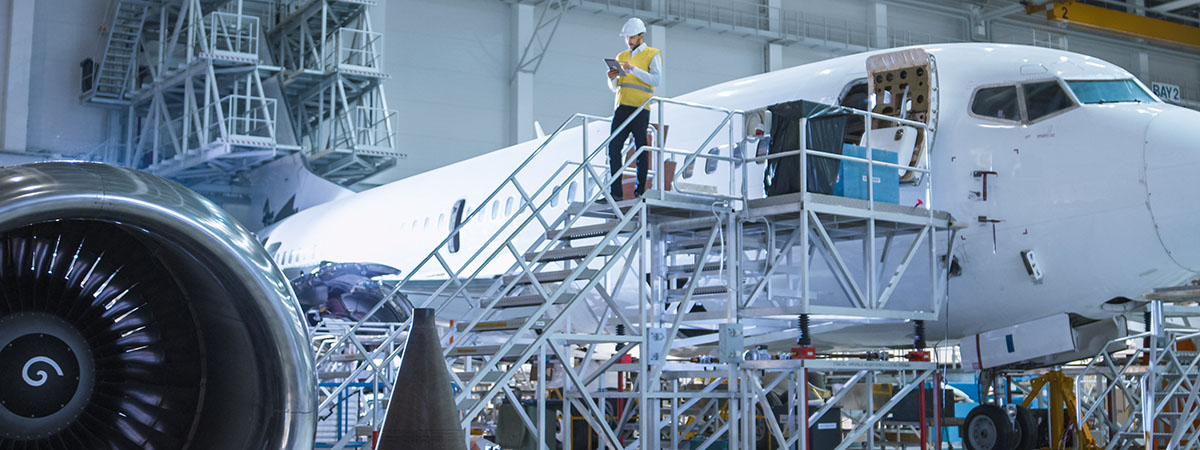
When talking about the aircraft maintenance and the requirements to be met in order to maintain their certificate of airworthinessIt is quite normal for most people to think of the moving parts, structure, engines or cabin equipment, as these are the most visible elements. But there is a big unknown part in this whole process which, in short, is the one that really actively manages the elements of an aircraft. avionics maintenance.
Aircraft systems maintenance offers a constant challenge to both external teams and technical personnel.
Avionics are known as the electrical, electronic systems and control equipmentThe use of aviation systems, which enable an aircraft to fly safely, navigate in a controlled manner and move from one place to another without error or mishap, is a key element of aviation safety.
The first flights at the beginning of the 20th century were a great feat, because they did not have any technology that allowed them to have real and complete control of the aircraft. They used a few hand-operated mechanical levers and pedals, which only allowed them to stay in the air for a few seconds. They soon realised that flying required control of many physical and technical aspects, and that they would need many years of research into the subject.
Throughout the second half of the century, following the technological breakthroughs of the Second World War, the civil aeronautics as a major sector of economic activity. Thus, the transport of people and supply of goods around the world now accounts for more than 10% of global GDP, and is expected to continue to rise in the coming years at a projected 4.3% per annum (pending only the real impact of the current pandemic and its consequences).
The need for aircraft to have more and more autonomy, greater comfort on any type of journey (short or long), greater load capacity, or an improvement in their general performance, has led to the inclusion of different systems to aid navigation and comfort in the cabin. These include aircraft navigation and automatic flight systems, cabin control and conditioning, control of external aerodynamic aspects, aircraft instrumentation systems, aircraft power supply and lighting systems, cockpit warning and training systems, communication and information management systems, electronic control systems for flight controls, electrical interconnections and protection systems, engine indication systems, fire-fighting systems, hydraulic systems, pneumatic systems, fuel and refuelling systems, loading systems, and so on. Increasingly, aircraft are adding technologies that need to be integrated in the same space where they have to coexist, as well as be functional with each other. In recent years, commercial aviation has undergone a major updating process in which the renewal of fleets with new aircraft that are more efficient in terms of fuel consumption and emissions, and with more sophisticated avionics, has played a leading role.
For some time now, digitalisation (especially the whole "more electric aircraft" concept) has also been a further step in the evolution of aircraft. Today, the inclusion of fibre optics and state-of-the-art computer equipment, make an aircraft increasingly a complex machine of hardware and software that needs to be serviced, updated and maintained with a strong digital, rather than mechanical, orientation.
In order to maintain these systems over time, in addition to the checks that in many aircraft are already integrated into the equipment itself, operators must have external equipment that connects to the aircraftThe large companies also need to have a large logistics network in place, spread around the world, of connection points where all these processes can be carried out. In addition, large companies need to have a large logistics network in place, spread around the world, of connection points where all these processes can be carried out.
Maintenance is carried out via interface modules. consisting of multiple electronic cards stored in one or more racksinstalled in the maintenance hangar and managed by different computers through a network of connecting cabling. This external equipment is expensive and large. They must be able to be operational around the clock, have extensive connectivity for different types of aircraft and be able to monitor and perform tests simulating the different ground/air conditions that an aircraft passes through during its working day. Due to the characteristics of fixed test equipment, airlines must schedule maintenance in advance, and have alternatives for the most urgent cases.
Currently, work is also being carried out on smaller, portable, versatile, more autonomous, more mobile and, consequently, more cost-effective external equipment for the execution of these processes. Companies such as AERTEC, in collaboration with AIRBUS Defence and Space, have been innovating in this field with the development of this type of equipment. This is the case of the portable device for carrying out functional tests, called the AIM Dongle.
This device is capable of connect directly to the aircraft by cable or wirelessly and test in any locationIt can send and receive a wide variety of signals, avoiding the need to constantly move the aircraft to fixed installations. This small device has already successfully passed laboratory tests and is now in the aircraft test phase. It is a major breakthrough in this field, as it facilitates the management and maintenance of the systems, and opens up the possibility of greatly improving time and availability, while significantly reducing the costs of this type of maintenance.
These portable devices are of great help to the team of technicians who carry out this type of testing and maintenance, as they allow them to have a small-sized device that they can easily move and, consequently, increase their productivity. Because we cannot forget that behind all this technology there is a large team of people who are in charge of carrying out the tests. These are the electronic systems and avionics maintenance technicians. These persons need to have a licence approved by the competent administration authorising them to carry out this type of maintenance and, in addition, they must have system-specific training.
This part of systems maintenance offers a constant challenge both to external teams and technical personnel, as well as to the testing means necessary to carry out this work, where the most advanced aeronautical technology is applied to ensure that the aircraft systems are in perfect working order.
From there... to fly.