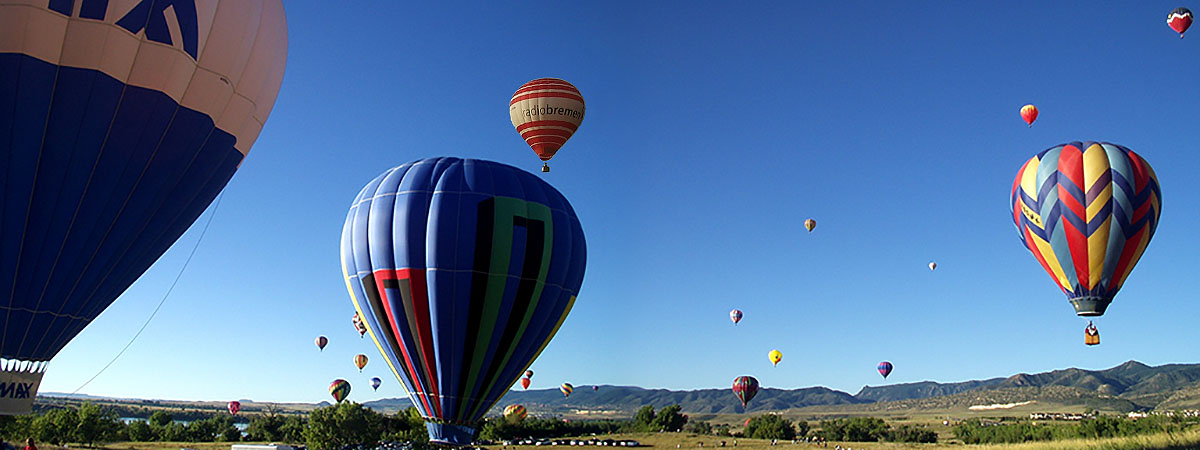
Since the origins of mankind, man has always longed for power. flyAs myths and legends from all civilisations have shown. When we think of the first men to fly, the pioneering Wright brothers almost always come to mind. But it was not they who were the first to fly, nor was the aeroplane the first device that enabled man to take to the skies and move about. hot air balloon.
The first recorded balloon to take to the skies was that of the brothers Joseph-Michel and Jacques-Etienne Montgolfier (two other brothers, curiously enough) on 5 June 1783. It was in the French town of Annonay and they managed to climb to 2000 metres, staying in the air for a long time. It was not, however, until 15 October 1783 that a man was lifted in one of these devices, a captive balloon that ascended some 80 feet. The daring pioneer in this case was Jean-François Pilâtre de Rozier who later, on 21 November of the same year, together with François Laurent, Marquis d'Arlandes, performed the first free balloon flight over Paris and its surroundings over a distance of 10 kilometres and an altitude of about 1000 metres.
The Wright brothers were not the first to fly, nor was the aeroplane the first device that allowed human beings to take to the skies and travel. It was the hot air balloon.
Once that longing to fly had been satisfied, man's next desire was to applying these new inventions to warfareas has been the case with every new development throughout history. In the case of balloons, they were used primarily as a recognition and observation tools. The forerunners were again the French, who began to use it during the defence of the French Revolution against coalition Europe.
The first actions of which there is evidence of their use for military purposes were in 1793 and 1794 in the sieges of Maubeuge and Charleroi where, despite the still primitive use of these balloons, their presence and usefulness had a decisive effect on the morale of the troops when their positions, movements and deployments were discovered. From this point onwards, their use was extended and perfected in other countries such as Spain, Italy and the United Kingdom.
From 1870 onwards, the European powers started to create Military Aerospace CorpsAt that point, the use of balloons in an organised and militarised way left countries without them at a great disadvantage.
Spain, as a power of the time, was also at the forefront in terms of balloons, creating in 1884 the Spanish Military Aeronautics, at least on paper, since it was not until June 1885 when the Telegraph Battalion of the Army Engineers acquired a first balloon to explore its applications in the military field. During the following years and mainly during the beginning of the 20th century, the use of balloons for military purposes was enhanced and developedThe project will be carried out in different modalities (captive, kite, probe, spherical with valve...), as well as by increasing the number of staff and personnel.
An illustrative example of the use and importance that aerospace was gaining in importance is what happened during the Cuban War between Spain and the United States. On 1 July 1898, the American troops on the island, under the command of General Shafter, attacked the Spanish positions near the Aguadores River. The Spanish troops, commanded by General Vara de Rey, held off the frontal assaults even though they were fewer in number, but much better instructed. In this situation, General Shafter decided to raise a captive balloon, from which the observers noticed that in a nearby jungle area there was a road that did not appear on any of the maps and was free of defenders. The information was immediately relayed via another new invention for warfare: the telephone. Although the balloon was quickly shot down by infantry riflemen, the information had already been transmitted.
The American troops advanced along the newly discovered trail, enveloping the Spanish position and wiping it out in numbers. The first orders for the re-embarkation of the American troops were already given when this information turned the tide in a war that was far from being in their favour. Later, General Adolphus W. Greely, Chief of the Signal Corps, would say of the use of the balloon and the telephone: "This action may have been a determining factor in the capture of San Juan Hill".
In 1901 the Aerostation Service of the Spanish Army was already operational and in 1902 Commander Vives, Chief of the Aerostation Service, wrote the first instructions to the officers in charge of directing free ascents.
On 25 October 1902, two inventions of Spanish aerospace were tested: the use of a ballast bag hung from the suspension circle at a distance of 15 metres; and the use of the statoscope (or statoscope)which indicated, like a variometer (vertical speed indicator), not only the direction of the balloon's vertical movement but also the rate of ascent or descent, allowing the amount of ballast that needed to be released to maintain the desired altitude at any given moment to be graduated with greater accuracy.
It is also worth noting how the launch of the first balloon probe on 3 March 1903, would give birth to a new activity, the National Meteorological Service, which would later develop with the air station playing a major role.
The Army Aerostation Company also proved its military usefulness in 1909 in the Melilla campaign, where it carried out important missions of observation, topographic survey and artillery guidance, making a great contribution to the military ground effort. This participation of a Balloon Section in the war was repeated in 1912, 1913, 1921 and 1925.
As the 20th century progressed, aviation developed around the world, both technically and in terms of numbers and manpower, aerostation was ageing due to its operational limitations and lack of evolution.. In Spain it languished until it disappeared in the Spanish Civil War of 1936, where aviation already played a decisive role.
In France, however, it was not until after the Second World War, in 1944, with the conversion of the Balma balloon station (Toulouse) into an air force reserve, that the last military units and infrastructures of the country that saw the birth of this new way of taking to the skies disappeared.