History sometimes forgets some pioneers, such as Abbas Ibn Firnas, the first man to fly a heavier-than-air craft and live to tell about it... in the 9th century.
Throughout human history there have been memorable people whose contribution to science can be considered exceptional. We know many of them and, specifically in the context of aeronautics, illustrious surnames come immediately to mind, such as Da Vinci, Cayley, Montgolfier, Montgolfier, Le Bris, Lilienthal, Ader, Pilcher, Whitehead, Zeppelin, Torres Quevedo, Santos Dumont, Wright, Alcock, Forlanini, de la Cierva, Lindbergh, Latécoère and a few dozen others. There are other names, however, who have gone down in history more discreetly, despite the fact that their contribution has certainly been remarkable. Such is the case of a scientist, historian, poet, inventor and, of course, aeronautical pioneer, such as Abbas Ibn Firnas.
Many people are surprised to learn that this man was the first to be able to fly with a heavier-than-air craft, It remained in flight for just over ten seconds. And it did so for more than a thousand years before the Wright Brothers, But who was Abbas Ibn Firnas?
His birth name was Abu al-Qāsim Abbās ibn Firnās and he was born in the year 810 in the environs of the city of Ronda (Malaga, Spain). Relatively little is known of his childhood, except that he acquired an extensive culture and began to excel in various disciplines, which led him inexorably to what was then the richest and most influential city in al-Andalus, Córdoba. There he excelled as a scientist, inventor, poet, philosopher, alchemist, musician and astrologer to such an extent that he was given the nickname Hakim Al Andalus (the sage of Al Andalus).
Once in Cordoba he developed his facets of knowledge extensively, contributing significantly to the advancement of science and the arts in the courts of the amirs Abderraman II (822-852) and Muhammad I (852-886).
In the scientific field it was the first to be used throughout the Iberian peninsula, and probably in Europe, Sinhind's astronomical tablesThese were of Hindu origin, which would later prove to be fundamental in the development of European science and would be studied in medieval universities as a subject in the Quadrivium (which included music, arithmetic, geometry and astronomy).
He introduced the technique for cutting rock crystal to the western world and even developed alchemy procedures to create crystals from different minerals.
He built for the Amir of Cordoba a clepsydra (Arabic for "clepsydra"). Al-Maqata-Maqata Al-Maqata-Maqata), a complex clock that uses water for energy, which is closed or opened by a series of valves and serves to tell the time at any time of the day or night, which was unusual for its time.
It also developed the first armillary sphere (or spherical astrolabe) from Europe, used for calculations and approximate astronomical observations by orienting the circles of the instrument according to the plane of the celestial circles.
As an example of its advanced astronomical knowledgebuilt in his residence in Cordoba a mechanically hinged planetariumwhich represented the celestial vault. He even set the scene with sound and visual effects that simulated the different meteors: the storm, lightning and thunder.
In the context of the aeronauticsAbbas Ibn Firnas is an extraordinary reference point as a forerunner of the parachute and for being the first person to designed, built and successfully tested devices that could be kept in the air. He did so six hundred years before Leonardo da Vinci developed his flying machine designs and more than a thousand years before the Wright brothers made their famous flight.
His first aeronautical milestone was in 852, when he jumped into the void from the minaret of the Mosque of Cordoba using a canvas as an innovative parachute. Nothing like this had ever been attempted before. Or, at least, no one had been able to tell the tale until that date. The result was a relatively quick descent, with a rough landing and several broken bones, but with the firm conviction that it could work. This is widely regarded as the use of the first parachute in history.
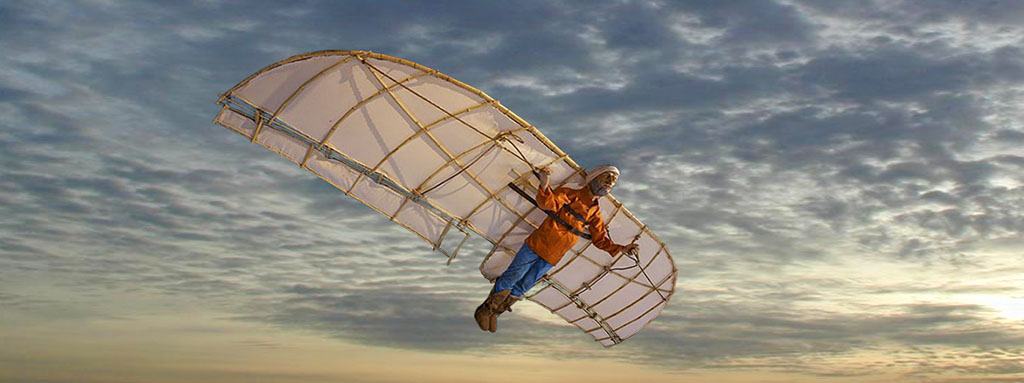
Years later, in 875, designed a glider out of wood and silk cloth (adorned with feathers of various birds, just like his clothes) with which he launched himself from the hill of Ruzafa, near Cordoba. Confident that this ingenuity would work, he had summoned hundreds of people along the route. Many members of the court of Muhammad I, emir of the Andalusian Caliphate, were also present. The result was a sustained flight taking advantage of the air currents, which lasted a little more than ten seconds. (there is no written record of the distance travelled). Control of the contraption was reportedly quite poor and possibly the cause of a crash landing in which he seriously injured both legs. He later attributed the problem to the need to incorporate a tail into the aircraft design. At the age of 65, too old for his time, he never tried again, but he became the first man in history to fly a heavier-than-air craft... and he could tell the tale.
The name of Abbas Ibn Firnas He now features on airports, bridges, hills, parks, avenues and scientific bodies, especially in countries with a Berber background, but what will surely remain for immortality is that one of the craters on the moon also bears his name.