Last summer, one of the best-known personalities in Spanish sport questioned, via the social network Twitter, the veracity of the man's landing on the moon in the Apollo missions. Fortunately, the networks were outraged and the focus of the debate was not the arrival or non-arrival of man on the moon but the seriousness of the fact that in the year 2018 there could still be part of society questioning this historic event.
Apollo 11 landed in the Sea of Tranquility on 20 July 1969, which means that 2019 marks its 50th anniversary. It was the first time that humans visited another world and, in the author's eyes, the first time that humans visited another world. the greatest adventure in human history.
Much has changed in the space race from the 1960s to the present day. The socio-political context, the technology, the budgets or the capabilities of today's administration are markedly different, although the challenge seems to be almost the same.
From the moment that President Kennedy uttered the words "I am a man of the cloth" to "I am a man of the cloth". "We chose to go to the Moon in this decade, not because it's easy but because it's hard", It was only seven years before Neil Armstrong left his first footprint in the Sea of Tranquillity. If today mankind is a long way from having the technology to reach the Moon, in 1962 the outlook was no better. Only one year had passed since the first manned orbital flight, but that flight had taken off from the other side of the Iron Curtain. US manned orbital flight experience was seven months, the time that had elapsed since John Glenn flew on the Mercury-Atlas 6 mission.
Given this context of obvious inexperience in a highly innovative technology, how could such an ambitious scientific-technological development be carried out in such a short time? It was undoubtedly a succession of meticulously planned projects, actions, challenges and events with a clear goal. Each mission had a reason and they were all part of a common project. Let's take a look at some relevant events during that period:
Sputnik crisis and the founding of NASA
On 4 October 1957, the USSR launched the first artificial satellite in history, Sputnik 1, from the Baikoniur Cosmodrome (the world's oldest and largest space launch facility, still in operation) as a contribution to the UN's proposed International Geophysical Year.
It was a very simple design (an aluminium ball inflated with nitrogen and two radio transmitters) but it demonstrated the Soviet Union's ability to put weaponry into orbitThe EU's space technology is also a major superiority over the United States.
The United States did not like the fact that it had an 80-kilogram Soviet ball flying continuously over its territory for months at a time. This triggered the so-called Sputnik crisis, which led to the founding of DARPA (Defense Advanced Research Projects Agency) to develop military space technology and NASA (National Aeronautics and Space Administration) to develop civilian space technology.
Mercury Programme
The first US manned space programme was the Mercury programme. The Mercury spacecraft was a single-seat capsule powered in the first suborbital flights by a Redstone rocket and later by an Atlas rocket for orbital flights. To crew the Mercury capsules, the first group of US astronauts, known as the 7 of the Mercuryall of them outstanding military pilots with extensive test flight experience and a very high level of technical training.
In the period 1960-1963 there were 11 Mercury missions (10 successful), 6 of them manned by humans, one manned by Ham the Chimpanzee, and 4 unmanned.
Gemini Programme
The Mercury programme was a first step towards Kennedy's goal, but more ambitious missions were needed to achieve this milestone. The Gemini programme began in 1965 and, although it is not usually remembered by the general public, it was the first step towards Kennedy's goal. fundamental to developing the technologies and techniques necessary to enable missions to the Moon.. The Gemini spacecraft was an evolution of the Mercury spacecraft: slightly larger, with a capacity for 2 astronauts and the possibility of orbit change manoeuvres.
A total of 11 flights were made between 1964 and 1966. Among the milestones of this programme, the following stand out:
- Prolonged stays in space (Gemini 7).
- Rendez-vous of two manned spacecraft (Gemini 7, Gemini 6A).
- Docking of two vehicles in orbit (Gemini 5, Gemini 8, Gemini 10, Gemini 11, Gemini 12 ),
- Extra-vehicular activities (space walks): Gemini 4, Gemini 8, Gemini 10, Gemini 11, Gemini 12).
In addition to this series of objectives set and achieved, the Gemini 8 mission left an extra legacy: Neil Armstrong's cool performance in resolving a critical situation in orbit that was close to a LOCV event (Loss of Crew and Vehicle or loss of the vehicle and crew). Once the Gemini 8 spacecraft had docked with the unmanned AGENA vehicle, the Gemini-Agena assembly began to spin out of control. Assuming that the origin of the rotation was a malfunction in the AGENA vehicle's propulsion system, they proceeded to undock, which made the situation worse, revealing that the problem was in the Gemini spacecraft and that the AGENA vehicle was in fact maintaining the rotation at a moderate value. The situation became critical, but Armstrong was able to respond: he was able to regain control and make a successful atmospheric re-entry...
Apollo Programme
Although the Apollo programme officially began in July 1960, the first manned flight did not take place until October 1968, with the Apollo 7 mission. The Apollo spacecraft had a capacity for 3 astronauts and a heat shield capable of withstanding atmospheric re-entry from a lunar trajectory. It consisted of a command module, a service module (unmanned) and a lunar module.
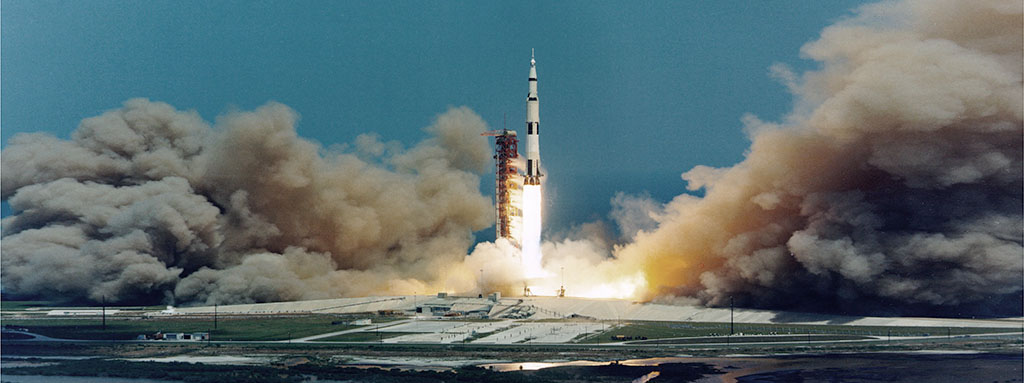
Apollo 11 on the launch ramp, July 1969.
To place this assembly in Earth orbit and perform the translunar injection, the rocket was constructed Saturn V, the launch vector with the largest payload capacity in history (118 tonnes to low Earth orbit). To put this in perspective, let's keep in mind that SpaceX's spectacular Falcon Heavy can "only" put 64 tonnes into low Earth orbit. With technology of this level in hand, it took only 4 giant strides and 7 months to reach the Moon:
- Apollo 8 (December 1968). First manned flight of the Apollo spacecraft and Saturn V launcher. First manned flight to escape Earth's gravity and orbit the moon.
- Apollo 9 (March 1969). First tests of the manned lunar module, in Earth orbit.
- Apollo 10 (May 1969). Separation and docking tests in lunar orbit between the command module and the lunar module. The Lunar Module descends to an altitude of 15km above the lunar surface.
- Apollo 11 (July 1969). First lunar landing. First extravehicular activity on the Moon and first collection of samples from the lunar surface.
The Apollo 11 mission was watched live by some 600 million people around the world and demonstrated the technological superiority of the United States over the Soviet Union, whose manned lunar exploration programme is (unfairly) only remembered for the spectacular explosions of the N-1 rockets.
In the interval between 1969 and 1972 there were 6 additional lunar missionswith 5 total successes and one partial success (the return of the Apollo 13 crew alive).
With the decommissioning of the Apollo spacecraft and the Saturn V rocket in 1975, mankind lost the ability to visit other worlds. Coinciding with the 50th anniversary of the success of Apollo 11, the US administration recently unveiled the Artemis programme, which aims to set foot on the moon again in 2024.
Much has changed in the space race from the 1960s to the present day. The socio-political context, the technology, the budgets or the capabilities of today's administration are markedly different, although the challenge seems to be almost the same. Will we see new footprints on the Moon in the short term?