Since the dawn of time, man has always tried to optimise all his tasks in such a way that they involve less physical and economic effort. In all cases, the priority is that these optimisations do not put his physical integrity at risk. This mentality remained present when man learned to fly, especially since this activity commands considerably more respect than other everyday tasks. For this reason, among others, optimisations in the aeronautical world are slow in comingAlways take a cautious approach.
Remote air traffic control at airports is a technology that has already proven its viability, safety and numerous benefits.
This is the case for remote air traffic control at airports (RTS, Remote Tower System), also called remote control towers. The idea is based on having a remote control centre (RTC) that manages several airportsThe new system, physically dispensing with the traditional control towers.
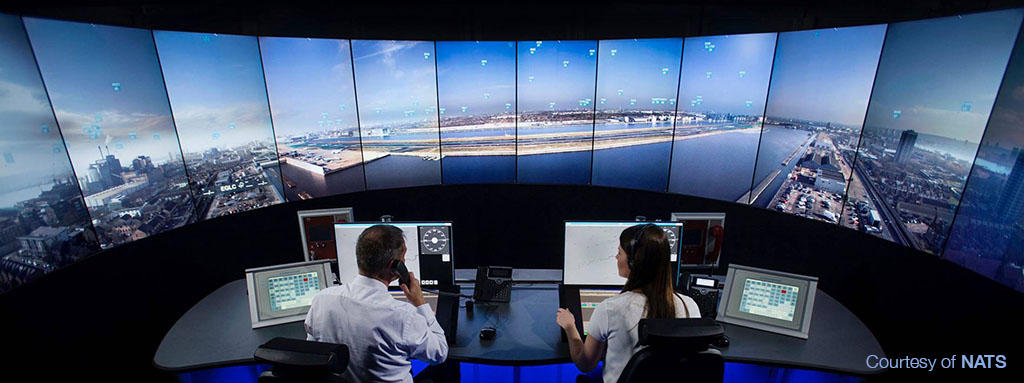
This system works with a series of high-definition cameras and sensors of different types located in a turret with visibility of the entire airport whose operations are to be controlled. The data is sent in real time to the remote control centre where, in turn, all the technical and human resources necessary to manage operations are available. The remote control centres, for their part, are equipped with large screens that can generate a 360-degree, high-definition image of each aerodrome to be controlled. Those who already use this type of installation say that, with this global image of the airport, together with the availability of other information systems that enrich what is displayed on the screens. (augmented reality), operationality is improved in terms of safety and air traffic management capacity.
A value to be taken into consideration is the cost reduction in air traffic control services, maintenance and associated personnel. It is estimated that these innovations can result in savings of 30-40 % of these costs, which is an interesting justification for airports with few operations.
In this sense, the implementation of such a system can be a very attractive to airport operators. By having a centralised control centre, it can offer more flexible air traffic services, even on demand and, moreover, with uninterrupted operation (24×7 service) without increasing costs. Ultimately, this is a solution that would improve economies of scale for certain airports, improving their profitability and efficiency without reducing safety.
One of the pioneers of this technology was the Ornskoldsvik Airportin Sweden, controlled from the RTC in Sundsvall, 155 kilometres away. The use of this technology was approved in October 2014, although it was not until April 2015 that 24-hour service began. Currently, with the system fully operational, the control tower at Ornskoldsvik Airport is completely empty.
The approval of the system by the Swedish authority was a long process that took about 10 years. Everything had to be in place so that the system created would integrate the highest standards of operational safety. Following the success of the first installations, new remote control installations are currently being implemented at different airports in Sweden, Norway, Germany and the United Kingdom. Just these days, Jersey Airport in the Channel Islands has become the first British airport to achieve approval for the operational use of a digital remote tower.
This technology is part of the objectives of the Single European Sky Air Traffic Management Research and Development (SESAR - SESAR) project. Single European Sky Air Research), which aims to modernising air traffic management in Europe and represents the technological basis of the Single European Sky. SESAR argues that RTS services can be implemented even at medium-sized airports and guarantee an AFIS service (Aerodrome Flight Information Service) and TWR (Aerodrome Tower Control). A remote control centre could also serve small airports, frequented by VFR flights (Visual Flight Rules or visual flight rules) which, lacking instrument systems, would have a lower workload, thus reducing service costs.
The benefits of this system can be:
- development opportunity for low-traffic airports
- cost-effective provision of air traffic services
- greater efficiency in the use of human resources and infrastructure
- alternative to new construction or maintenance of control towers
- on-demand air traffic service and greater schedule flexibility to meet customer requirements.
- improving operational safety through new technology
- low cost contingency solutions
Air traffic controllers are essential at airports with a high volume of operations. However, the technological advance of RTS can be a very interesting alternative for air traffic service providers at certain airports. The main benefit could be the optimisation of technical and human resources in control towers of smaller airports, especially in off-peak seasons or at off-peak times.
As an example, we can consider the case of Spain, where 62.5 % airfields do not reach 60 operations per day, so it does not seem unreasonable to think about implementing this technology in some of them.
New technologies make it possible to access more information and promote a greater accuracy and immediacy of data for decision making during airport operations. This achieves better results in terms of operational safety and airport performance.
It is normal that some of those involved in air transport are somewhat suspicious of a technology that excludes the direct presence of human beings in the development of operations, but the experiences already underway have demonstrated not only its viability, but have also shown many advantages and, above all, compliance with the highest safety standards.