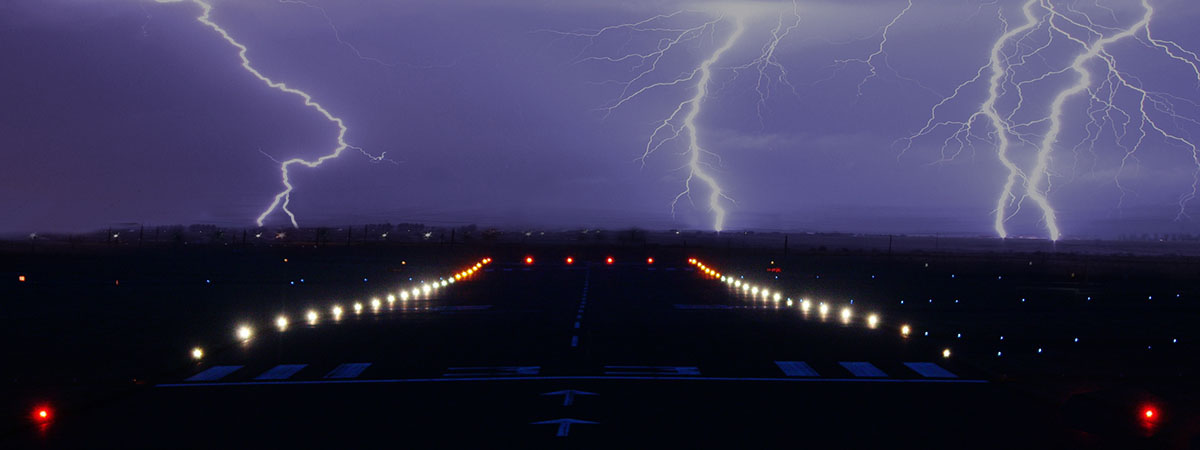
Storms are one of the most meteorological phenomena The most fascinating and intense storms on earth, especially if you are a sailor. For as long as mankind can remember, spotting a storm on the horizon has always been a threat to be reckoned with. It is a phenomenon characterised by the encounter between two or more air masses of different temperatures, resulting in a disturbance of the atmosphere. This results in strong winds, rain, lightning, thunder, lightning and even snow. It is certainly not the ideal scenario for travelling, but sometimes there is no other option, you have to go through them.
Every day, several aircraft are struck by lightning in flight, but this is a phenomenon that does not affect safety and hardly disturbs the normal course of the flight.
Among all the effects of a thunderstorm, one of the most feared is lightning. A powerful natural discharge of static electricity which generates an electromagnetic pulse capable of creating an instantaneous power of one gigawatt, i.e. 1 billion watts.
It is clear that, although nowadays the means to predict the weather are very advanced, it is not possible to predict where and how a lightning strike will take place accurately. In the aeronautical context, aircraft can attract lightning, especially on take-off and when passing through stormy areas. On average, an aircraft is struck by lightning once a year. This happens in a fraction of a second and without the passenger noticing anything more than, possibly, a flash of light on the outside of the aircraft.
So how is it possible for them to escape unharmed?
What makes the difference is a physical phenomenon known as the Faraday cage. This effect is responsible for the fact that, when lightning strikes an aircraft, the sum of the electric field and the magnetic field inside is zero. How the Faraday cage works is based on the properties of a conductor in electrostatic equilibrium. When the metal cage (the plane) is placed in the presence of an external electric field (the lightning), the electrons, which in a metal are free, move in the opposite direction to the electric field and are placed on one side of the cage. In this way, an abundance of negative charge is created and, as an opposite effect, the opposite end is depleted of electrons and an abundance of positive charge is formed. This is known as polarisation of an electrical conductor (negative pole and positive pole), which, as a result, creates a magnetic field of equal magnitude to the electric field that generated it, but in the opposite direction. This is how the forces of the two fields counteract and cancel each other out. It is also important to note that current conduction occurs around the outside whenever the cage is closed, as in the case of an aircraft or a car.
This phenomenon is also used to protect electronic equipment sensitive from external radio frequency interference (RFI), as well as to enclose RFI-producing devices, preventing their radio waves from interfering with other nearby equipment.
In December 1963, a turning point in aircraft lightning safety was marked. It came about because of the fatal crash of Pan Am Flight 214. A Boeing 707 flight took off from San Juan (Puerto Rico) bound for Baltimore (Maryland). It was struck by lightning in mid-flight at Elkton (Maryland), igniting fumes from the fuel tank, which caused an explosion on one of the wings. At 8:59 p.m. the plane went down in the cornfields of Elkton. There were no survivors.
Following the accident, in 1967, the US Federal Aviation Administration (FAA), updated security standards of fuel tanks to prevent ignition by lightning strike. In 1970, the following were also added preventive requirements for other aircraft components. This accident raised awareness in the aviation world about aircraft lightning safety. Since that time, not only the FAA, but also the various international bodies concerned with aircraft safety have been constantly updating preventive safety measures in this field.
Today we already know that the aircraft behaves like a driver because it is made of metal. However, this may at first appear to be a major drawback for aircraft made of new-generation materials. Such is the case of the Boeing 787 Dreamliner or the Airbus A350 XWB, which are made of a large number of composite materials, mainly carbon fibre. At the lightning laboratory of Cardiff University (Wales), they tested the effect that lightning could have on a carbon fibre composite sheet. The important conclusion was that the damage caused by lightning to a material such as carbon fibre is quite significant and can be fatal in mid-flight.
The solution designed to counter this drawback was simple: cover the composite material by a mesh made up of some light conductor. If the mesh is placed as an envelope, it is sufficient to achieve the Faraday cage effect in the composite components that make up the aircraft. In this way, the new composite-intensive aircraft are capable of protect against lightning without compromising on its excellent performance.
There are many examples of such phenomena, but here we show just two videos of how a lightning strike on an aircraft does not affect its flight.
The flight was a Boeing 777-300 flying from Schiphol (Amsterdam) to Lima (Peru). In the video you can see how it was struck by lightning during take-off, but still continued its flight normally and without any consequences. The video went viral before the plane reached its destination. Passengers did not know about it until they landed in Lima and were able to watch it on their own mobile phones.
Another visual example of a lightning strike on an aircraft can be seen in this other video:
Shot by a university student, it shows how a plane is struck by lightning in mid-flight near Seattle-Tacoma airport (USA) and continues the flight without incident.
Enjoy a happy flight... even in a storm.