What makes an airport functional, efficient and future-proof? Many would say planning, technology, regulatory compliance and strategic design. And they would be right. But the truth is that behind every successful project, there is something more. Something deeply human: a purpose-driven team, a well-supported customer and a vision that connects ideas, people and solutions.
At the heart of every great airport is a vision. And behind that vision, a team. Functional airport design is not just a matter of calculations or regulations. It is, above all, an exercise in strategy, foresight and leadership that defines how such complex infrastructure adapts to the future while continuing to meet the needs of the present.
Functional design means defining how the airport should evolve to meet future demand, taking an integrated view of the short, medium and long term. It is not just a matter of designing infrastructure, but of anticipating needs that do not yet exist, and devising solutions to problems that have not yet arisen.
Strategy. Without vision, there is no airport
This strategic process begins with a detailed analysis of the current state of the facilities – including terminals, runways, access and car parks – and results in a coherent, adaptable and, above all, realistic growth proposal.
Functional design is not merely a theoretical exercise, nor a collection of attractive plans. It is comprehensive planning that covers everything from the configuration of passenger, vehicle and aircraft flows to the user experience, operational resilience and sustainability of the model.
Good functional design is structured around rigorous methodology that includes:
- Analysis of the current situation: the airport’s subsystems, their level of service and any existing bottlenecks or problems are examined.
- Calculation of future needs: demand is projected for passengers, operations and fleet.
- Study of alternatives: technical and economic options are evaluated, considering operational impact and construction feasibility.
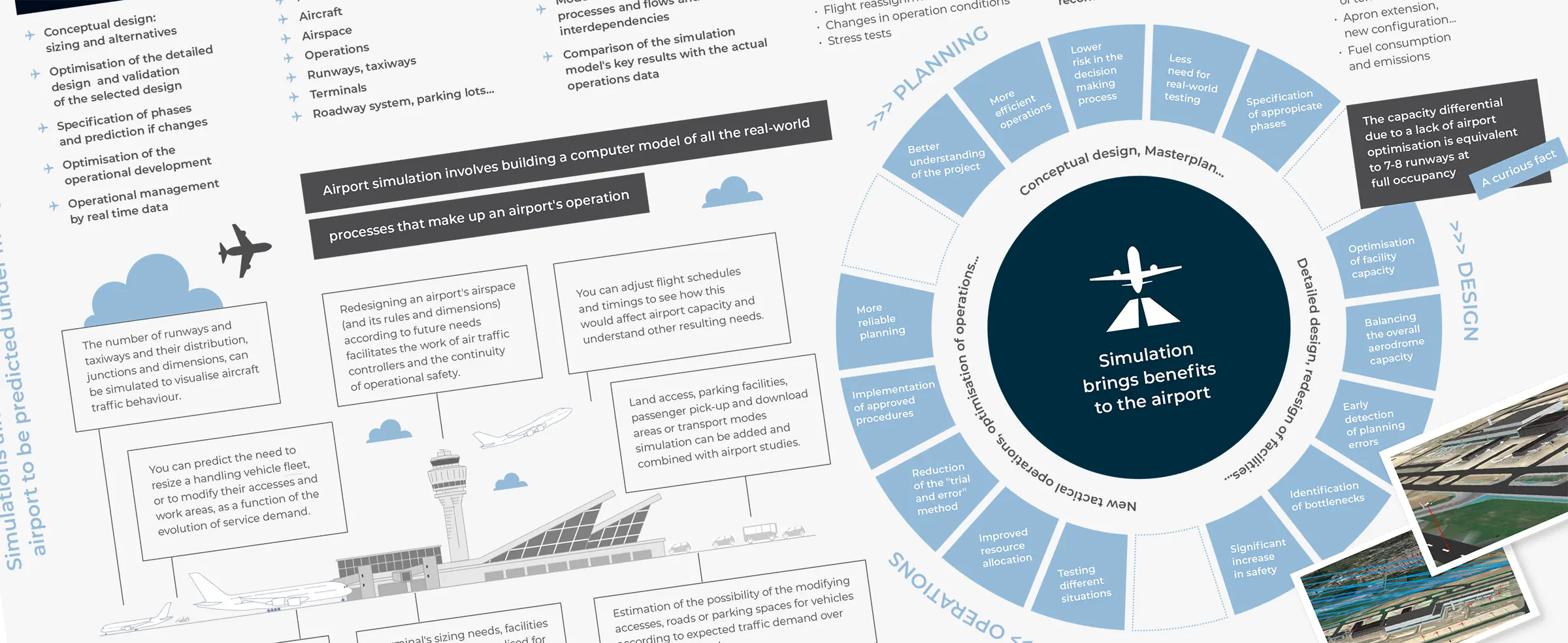
- Functional simulations: advanced digital tools (BIM models, flow simulators) are used to validate decisions.
- Phased development: implementation is planned in stages, minimising interference with current operations.
Functionally designing an airport is a dynamic, multidisciplinary process that requires the input of operators, airport managers, airlines, security forces, engineers, architects and, of course, end users.
Airports operate in a rapidly changing environment, whereby new safety regulations, emerging technologies, geopolitical tensions, social and economic transformations, and even global pandemics can radically alter traffic patterns and operational requirements.
Added to this are internal constraints, such as inherited infrastructure, disorderly growth and incompatibilities between old and new systems. The challenge lies in transforming without disrupting. Innovating without breaking down. Building the future without blocking the present.
Functional design must therefore be flexible, capable of overcoming obstacles and adaptable, rather than a closed response. Its goal is to build infrastructure that grows in an orderly manner, with decisions that balance technical, economic and human considerations.
Effective leadership. Leadership that cannot be seen, but can be felt.
If there is one thing that sets brilliant functional design apart from merely adequate design, it is the quality of the team that develops it. And, above all, the leadership that guides it.
Leading a functional project is not just about coordinating tasks or meeting deadlines. It involves:
- Listening actively to all stakeholders.
- Identifying needs, even those that are not verbalised.
- Managing conflicting priorities.
- Translating technical objectives into clear operational decisions.
- Aligning multidisciplinary teams around a shared vision.
Just like in an orchestra, where the conductor does not play any instrument but makes everything sound harmonious, the functional design leader must integrate engineers, planners, architects, technicians, analysts, customers and authorities, orchestrating a collective effort that goes beyond the blueprint.
The customer is also part of this orchestra. And there is often more than one (operational, institutional, financial), with different expectations that have to be aligned with one another. Therefore, functional leadership also requires effective communication, understood not as the art of speaking well, but as the ability to listen, interpret and convey meaning clearly.
Designing the future from the present
One of the most common mistakes in infrastructure projects is to think that it is enough for the plan to be well calculated or presented. But the true value of functional design lies in its ability to anticipate, build the future from the present and serve as a roadmap for a living, changing infrastructure with a complex life cycle.
In addition, functional design improves the passenger experience:
- Agile flows.
- Efficient intermodal connections.
- Reduced waiting times.
- Universal accessibility.
Well-designed infrastructure is almost invisible to those who use it: everything flows and everything is where it should be. That feeling of ‘everything being well organised’ that we get in some airports around the world is no coincidence: it is the result of hundreds of functional decisions taken with rigour and vision.
The airports of tomorrow will be technological, energy-efficient and user-focused hubs that blend into their surroundings. And functional design is the cornerstone for achieving that model.
Planning is not predicting: it is preparing with intelligence and flexibility. Good functional design does not just make the airport work better: it gives it meaning. It becomes a living space that accompanies travellers, represents their city and bridges both regions and cultures.
After many years working on airport projects, I firmly believe that – in addition to plans, models and regulations – what makes an airport a great example of infrastructure, what makes it truly special, are the people behind it: the leaders who inspire, the teams who are committed, the customers who trust us and the professionals who believe that their work can improve the experience of thousands of passengers every day.
Because, ultimately, an airport is not built on data alone. It is built on strategy, on people... and on the future.
Key topics in this post: Airport planning and design