Millions of passengers pass through airports around the world every day. Tens of thousands of passengers pass through any moderately important airport, and this can reach up to a hundred thousand at peak times. And to this reality must be added the hundreds of workers who work in its facilities 24 hours a day, 7 days a week.
A emergency situation requiring evacuation to so many people, it makes it all a challenge from an architectural, engineering and managerial point of view. From the architectural design through to the engineering aspects, evacuation routes and exits must comply with the various regulations that address these more technical aspects. Capacities, distances and evacuation heights, sizing and functionality of evacuation elements, emergency power supply and lighting, signage, alarm installations, public address and pre-recorded public address systems, external concentration or meeting points, evacuation of people with reduced mobility, among others, must be adequate to guarantee the success of an airport evacuation. In other words, "everything must be correctly designed and functionally correct.".
Appropriate architectural, engineering and management criteria mean that airport evacuation plans are becoming increasingly detailed and, above all, effective.
As a general rule, two of these three aspects coexist efficiently, adapting the necessary means of evacuation to the capacity of passengers, users and workers. However, this is not the case for the management aspect of evacuation, whose three aspects that give it meaning; the coordinationthe organisation and the control, makes them the aspects that need to be managed formerly y during the evacuation process itself in order to avoid two of the most common risks in any evacuation; the stampede effect and the entrapment effect.
The stampede effect occurs when people initiating an evacuation move erratically towards an exit, either because they are following others, based on the unconscious belief that the other person knows where to go, or because the exit coincides with the access route to the premises from which they now wish to leave. It is a very human and natural thing to leave the way we have entered, but in an emergency situation, this exit may not be the most appropriate.
The entrapment effect occurs when the "supposed" evacuation exits are not functionally operational, causing the trapping of all those who try to leave. The volume of people concentrated there can be so high that the collective panic creates an "immovable mass" incapable of turning back. For all these reasons, the correct management of an evacuation is of vital importance in order to avoid these two risk situations, which are sometimes the main generators of casualties, even though the other two more technical aspects are perfectly fulfilled.
An evacuation needs to be coordinated and organised. formerly of the start of the evacuation. Avoiding the triggering of the evacuation alarm or siren in public areas, before having the evacuation coordinated and organised, is essential to correctly manage the evacuation of people, especially those who are not familiar with the airport facilities, such as passengers and users.
In addition, having a Evacuation Equipmentas the Airport's In-House Emergency Team, is another vitally important aspect, being its quantity y quality two of the key factors in ensuring the success of the evacuation. When talking about quantityIn other words, the evacuation teams must be sufficient to respond to the large number of passengers and users passing through the airport. These evacuation teams must not only be made up of the airport's own workers or those integrated into it, such as the different passenger services, FFCCSE, security guards, airline handling and check-in agents, PRM service, but also of all those workers who form part of the companies known as "tenant companies", whose activity is to offer services classified within the tertiary sector.
Including all employees of these companies is not a dogmatic criterion, nor is it an objective to be pursued from an operational and functional point of view. The question then arises, where is the selection criterion? The criterion for selecting the workers of the tenants who will form part of the Evacuation Teams integrated in the Airport will be determined by the need that the tenant's own emergency or self-protection plan infers. That is to say, depending on the activity of the tenant, its own emergency or self-protection plan will define the need or not to have its own evacuation team. If so, the tenant's evacuation team should be integrated into the airport's evacuation processes, as the evacuation will ultimately take place through the airport facilities. Catering companies that are not "walk-through", companies that manage the VIP lounges, shops or department stores and/or that have fitting rooms, companies that manage the car park, car rental companies, would be some examples of tenant companies that should have evacuation equipment integrated into the airport evacuation process.
This aspect, not being developed by the regulations, which do not establish a relationship between the number of passengers/users and the number of people forming part of the evacuation teams, we could say, without fear of being wrong, that any tenant who has more than one worker per shift and who offers services to clients/passengers, should have an evacuation team included in their emergency or self-protection plans and integrated in the airport evacuation procedure.
In relation to the qualityIn order to ensure that the evacuation teams, both in-house and integrated, are well informed, educated and trained to adequately manage the evacuation procedures established by the airport. Aspects such as the control of collective panic, to the manual opening of all types of doors that are evacuation exits and routes, are premises of vital importance. This information and theoretical/practical training must be provided directly by the airport, familiarising and training the evacuation teams by means of training sessions and partial or general evacuation drills of the terminal. In the same way that the aeronautical industry demands the evacuation of aircraft within 90 seconds, an airport should have a time limit that guarantees the rapid clearance and evacuation of a fire area or sector in less than 3 minutes.
Another aspect of management is to determine the evacuation directions to follow, either to the airside or to the landside. Evacuating passengers who have already passed through the security checks from the airside to the landside is a real setback if the emergency causing the evacuation turns out to be a false alarm. Likewise, reducing or eliminating all elements close to the evacuation routes that propagate fire and/or generate black and toxic fumes is another fundamental premise that guarantees the success of an airport evacuation.
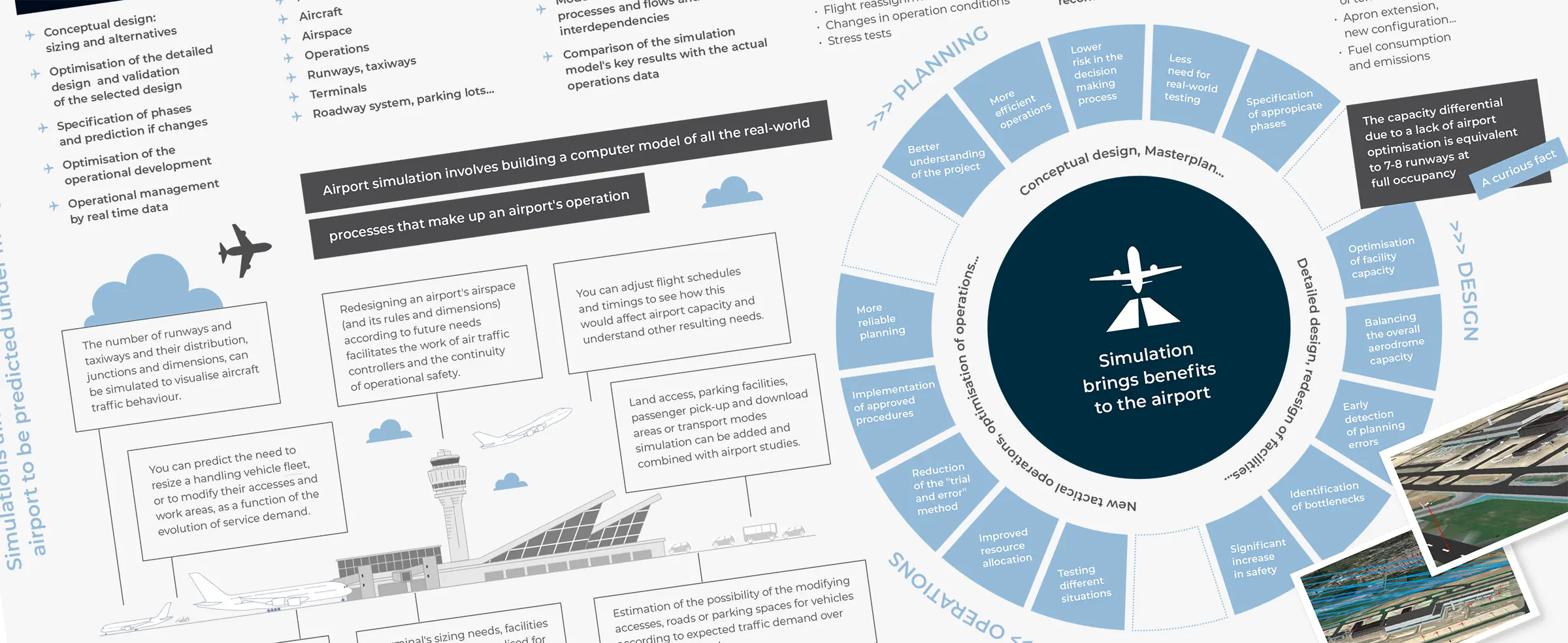
On the other hand, the use of computer tools to simulate different evacuation scenarios is a task that would otherwise be almost unfeasible due to the large number of people required in the simulation.
Last but not least, the evacuation of workers is limited to informing them of the evacuation procedures established by the airport, once the notice to evacuate a partial or general area of the airport is communicated. The familiarisation of workers with the exits and evacuation routes, as well as the evacuation procedures established by the airport, is a requirement that falls directly on each of them and their respective companies, once they are informed of them by the airport.
The ultimate goal of an evacuation plan is to saving as many lives as possibleThe evacuation plan should be properly designed, maintained and managed. Fortunately, the vast majority of airports around the world have adequate and up-to-date evacuation plans that allow the millions of passengers passing through them to be confident that any incident will be dealt with effectively.