If we take a look at any of the websites that allow us to see the flights that are operating between airports around the world, it is clear that the situation is totally anomalous. The fall in air traffic compared to the same time last year is dramatic and will influence not only the aviation sector but also the world economy in the coming months and years.
As a direct consequence of COVID-19, global air traffic has been reduced to less than half of what it was a year ago at this time.
As the coronavirus has evolved over the past few months, the travel restrictions have been drawing a different world. Let us bear in mind that almost 90 % of the world's people are currently subject to some form of movement restriction. in the context of actions to combat the COVID-19 pandemic. In addition, more than 40 % of the world's inhabitants live in countries where borders are totally closed.
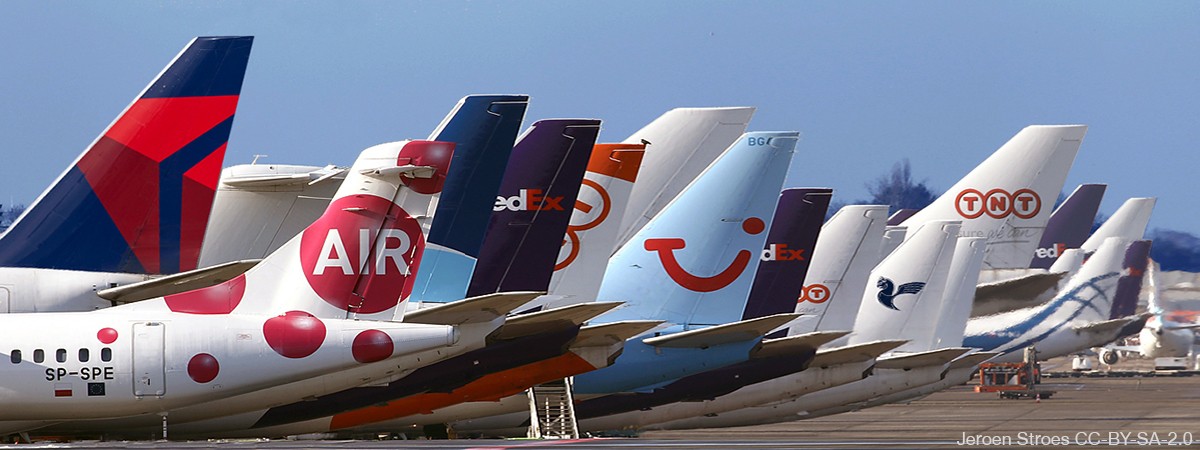
This directly affects global air trafficwhich has registered in the last week of March (the most affected week in this evolution) a drop of 55 % compared to the same period in 2019. As a direct consequence, more than a hundred airlines around the world have already grounded their aircraft, interrupting their activity. Still, there are certain nuances to consider.
Firstly, the domestic air traffic is being affected very differently from country to country, while international commercial flights are virtually paralysed. Cargo flights have also been affected differently, but to a lesser extent than commercial flights.
Most of the flights currently being conducted are focused on the domestic environmentsespecially in large areas of borderless movement. This is the case of China, where internal mobility is maintained of its hundreds of millions of citizens and where everything points to a slight return to normality. In fact, some of the country's airlines have already presented their domestic flight schedules from May onwards with frequency and capacity levels similar to those of a year ago. As far as international flights are concerned, however, no improvement is expected in the short term.
The case of the United States is particularly striking. Despite the dramatic decrease in air traffic, especially during the first week of April, the density of aircraft in flight continued to exceed to that of the rest of the world (with the exception of China, which has already been mentioned). In the light of the pandemic's evolution, airlines are already preparing plans to temporarily closeThe US government, however, seems to attach more importance to how air traffic affects the country's economy than to its role as a vehicle for the transmission of the pandemic. Unlike in Europe, however, the US administration seems to attach more importance to how air traffic affects the country's economy than to its role as a vehicle for pandemic transmission. Perhaps for this reason it does not end up taking drastic decisions, but is looking at a wide range of contingencies and plans to address them.
Finally, there is another important aspect to consider in the global context such as the ability of the air traffic control system to maintain its performance full. The vulnerability posed by the contagion of personnel has already forced the closure of air traffic control facilities in the United States (Chicago, New York, Las Vegas...) and all indications are that similar situations may occur in other countries where air traffic density has not fallen significantly.
It is evident that the COVID-19 pandemic is being a major negative event for the aviation sector in the global context. In the immediate term, there is no choice but to adapt to the containment measures issued by each government and to try to protect the people who depend on our economic activity. However, we also need to use this time to establish the measures that will enable us to overcome The aim is to deal with the consequences of the crisis in the shortest possible time and to maintain the air transport sector as the engine of development that it has been until now.